
Choosing the right cushion should not feel impossible.
Yet for many people in pain, it does.
If you are dealing with tailbone pain, sciatica, hip discomfort, or numbness from sitting, you have likely tried many options.
Most promised relief.
Few delivered results.
This guide explains why SP1KE™ cushions are fundamentally different, not just different in marketing language.
At Vigurus Technologies Inc., we do not just design support surfaces.
We use them daily.
We sit on them.
We stand on them.
We kneel on them.
We lie on them.
That matters more than most people realize.
The Cushion Market Is Full of Identical Claims
Almost every cushion promises the same benefits:
- Pressure relief
- Breathability
- Comfort
- Portability
- Pain reduction
- “Game-changing” materials
For someone in pain, those words sound reassuring.
But they do not explain how relief actually happens.
Pain relief is not a slogan.
It is physics, material science, and human biology working together.
When everything claims to do the same thing, consumers often choose based on price, reviews, or desperation.
That is rarely the right way to choose a medical or ergonomic support surface.
Why Cushion Choice Is Especially Hard for People in Pain
People living with chronic pain are not shopping for comfort.
They are shopping for function.
Many are dealing with:
- Sciatic nerve compression
- Coccyx or tailbone pain
- Poor circulation
- Post-surgical sensitivity
- Long hours of sitting
After repeated failures, many stop searching.
Some turn to medication instead.
The reality is simple:
Not all cushions can perform the same function.
If they could, materials, structure, and patents would not matter.
They do.
Why Materials Matter More Than Marketing
Let’s break down the most common cushion types and why they fail many users.
Air Cushions: Why They Collapse Under Pressure
Air cushions are often made from vinyl or plastic.
Some include raised nubs.
Most promise pressure relief.
Here is what actually happens:
- You sit down
- Air displaces outward
- The center collapses
- Pressure increases under the tailbone
Unless the cushion has a true structural cut-out, pressure concentrates exactly where relief is needed most.
Your hips spread.
Your tailbone sinks.
Your posture destabilizes.
If the air cushion has fixed nubs, they do not adapt to movement.
They push straight up, regardless of load or angle.
Result:
More pressure, less control, and increased instability.
Gel Cushions: Comfortable at First, Then Problematic
Gel cushions often look similar to SP1KE™ cushions.
They may feature an open grid design.
They usually feel good initially.
But gel behaves differently under sustained load.
After several minutes:
- Gel walls soften
- Structure collapses
- Body sinks downward
- Pressure increases over time
Gel does not provide progressive resistance.
It does not gently push back.
It absorbs load, then gives way.
Gel cushions are also heavy.
Many weigh up to six times more than a SP1KE™ cushion.
Most have weight limits.
SP1KE™ does not.
Why SP1KE™ Is Not “Just Another Open Grid Cushion”
SP1KE™ cushions look different because they are different.
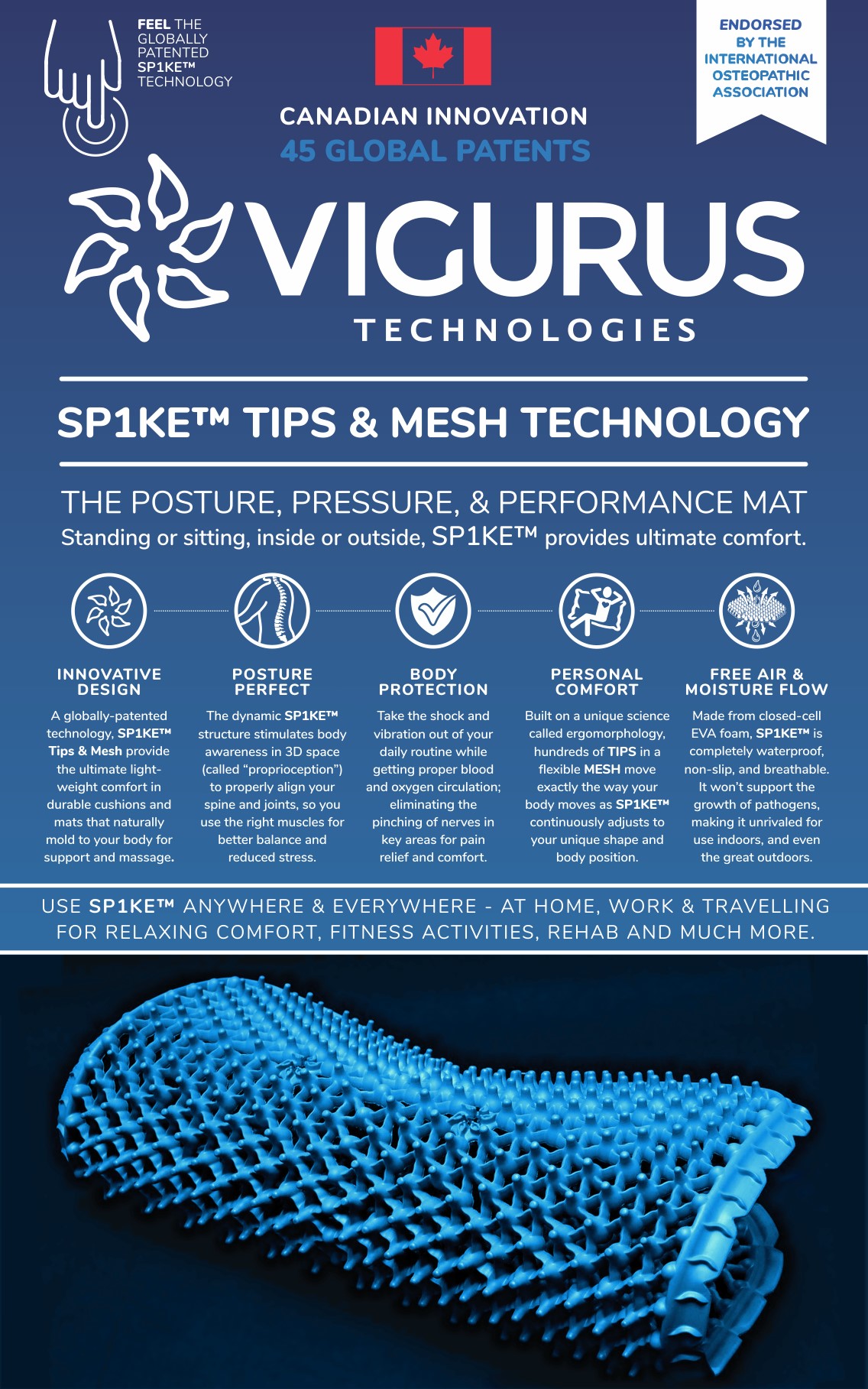
They are built on a globally patented Tips & Mesh architecture developed by Vigurus Technologies.
This structure does not collapse.
It redistributes load in three dimensions.
The Science Behind SP1KE™ Tips & Mesh Technology
Each SP1KE™ cushion is made from advanced closed-cell EVA foam.
EVA is:
- Lightweight
- Durable
- Hydrophobic
- Resistant to compression fatigue
But the real difference lies in the geometry.
Progressive Resistance Explained Simply
SP1KE™ tips are smaller at the top and wider at the base.
That means:
- Light users engage fewer tips
- Heavier users engage more structure
- Deeper compression increases resistance
The cushion adapts to you, not the other way around.
You stay on top of the surface.
You do not sink into it.
Why “Not Bottoming Out” Matters
When a cushion bottoms out:
- Pressure spikes
- Circulation decreases
- Numbness increases
- Pain returns
SP1KE™ cushions maintain their open grid shape under load.
This keeps your body:
- Suspended
- Balanced
- Aligned with gravity
Your posture improves naturally.
Load Redirection vs Load Absorption
Most cushions absorb load.
SP1KE™ redirects it.
This distinction matters.
Load redirection means pressure spreads laterally, not vertically.
It moves away from sensitive areas instead of pushing upward.
This principle is used in advanced protective systems, not consumer cushions.
Why SP1KE™ Enhances Blood and Oxygen Flow
Your body is never completely still.
Even micro-movements matter.
As you shift slightly:
- SP1KE™ tips flex
- Skin and tissue receive gentle stimulation
- Blood flow increases
- Oxygen delivery improves
This dynamic response helps prevent:
- Numbness
- Tingling
- Heat build-up
- Pressure fatigue
Static foam cannot do this.
Breathability That Actually Works
SP1KE™ cushions remain open under load.
Air moves freely through the grid.
Heat escapes.
Moisture does not build up.
This matters for:
- Long sitting sessions
- Wheelchair use
- Medical recovery
- Warm environments
Breathability is not about holes.
It is about maintaining structure while loaded.
Why Patents Matter in Cushion Design
SP1KE™ technology is protected by a large global patent portfolio.
That matters because:
- The design is not cosmetic
- It cannot be legally copied
- Performance is engineered, not guessed
Many cushions rely on appearance, not defensible engineering.
SP1KE™ does not.
Why SP1KE™ Has No Weight Restrictions
Most cushions specify user weight limits.
That is a sign of structural weakness.
SP1KE™ cushions scale load automatically through progressive resistance.
One cushion supports:
- Petite users
- Larger users
- Dynamic movement
No adjustments required.
Where SP1KE™ Technology Is Used
SP1KE™ technology is used beyond consumer seating.
Applications include:
- Clinical environments
- Rehabilitation settings
- Medical support surfaces
- Occupational seating
This is not lifestyle cushioning.
It is functional surface engineering.
Who Benefits Most From SP1KE™ Cushions?
SP1KE™ cushions are especially helpful for people experiencing:
- Sciatic pain
- Tailbone pain
- Hip discomfort
- Poor circulation
- Post-surgical sensitivity
- Long sitting hours
They are also ideal for people who have tried everything else.
How SP1KE™ Differs From “Massage” Cushions
Many cushions claim massage benefits.
SP1KE™ does not vibrate.
It does not compress randomly.
Instead, it provides continuous micro-stimulation through movement-responsive tips.
This is subtle.
It is intentional.
It is effective.
Durability That Does Not Fade
SP1KE™ cushions do not pack out.
EVA foam resists permanent deformation.
The grid structure maintains integrity over time.
This means:
- Consistent performance
- Long service life
- Fewer replacements
Cheap cushions feel good briefly.
SP1KE™ performs long term.
Frequently Asked Questions (FAQ)
Do SP1KE™ cushions help with sciatica?
Yes.
They reduce pressure concentration under the pelvis and tailbone.
Are SP1KE™ cushions firm or soft?
They feel responsive, not hard.
Support increases with load.
Can SP1KE™ cushions be used all day?
Yes.
They are designed for extended sitting.
Do they trap heat?
No.
The open grid allows continuous airflow.
Are SP1KE™ cushions medical devices?
They are engineered support surfaces used in clinical environments.
Final Thoughts: Why SP1KE™ Is Different
SP1KE™ cushions are not trying to sound better.
They are built better.
They are engineered to work with your body, not fight it.
They redirect load instead of collapsing under it.
They support circulation, posture, and comfort together.
If you have tried many cushions and found none that worked, this is why.
And if you want to talk to us directly, we welcome it.
We believe informed choices lead to better outcomes.